
OEM or ODM for a Hotel Scent Line: The Sample-to-Bulk Handover
Choosing between OEM and ODM for a spa or hotel scent line is really a question about where the handover happens. Under OEM the brand brings the formula and the factory scales it; under ODM the factory develops the scent and the brand approves it. Both models produce good amenity lines, but they put the handover risk in different places, and a hotel programme exposes those places faster than retail does. The decision is better made before sampling starts than after everyone has fallen for a vial.
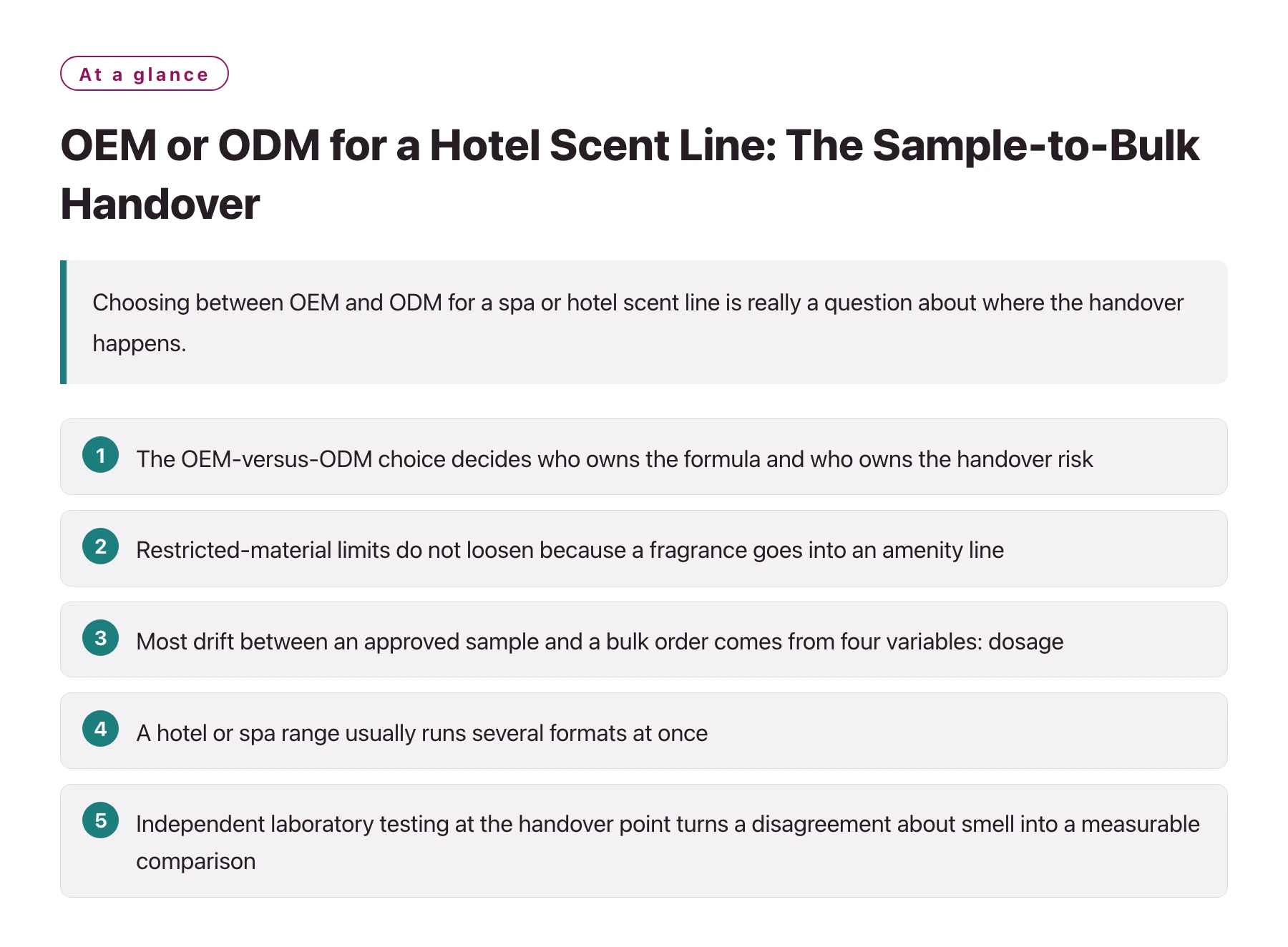
Key takeaways
- The OEM-versus-ODM choice decides who owns the formula and who owns the handover risk, so it belongs at the start of the project rather than at the end of the sample round.
- Restricted-material limits do not loosen because a fragrance goes into an amenity line, so the compliance picture has to be settled at brief stage and carried through every format in the range [1].
- Most drift between an approved sample and a bulk order comes from four variables: dosage, base, filling conditions and the retained reference. Freeze all four in writing and the handover becomes a comparison instead of an argument.
- A hotel or spa range usually runs several formats at once, which means the same scent direction may need trials in a wash, a lotion, an oil and a room spray rather than a single application test.
- Independent laboratory testing at the handover point turns a disagreement about smell into a measurable comparison, which is usually cheaper than reworking a bulk batch [2].
Hotel and spa buyers rarely get to choose a fragrance the way a perfume house does. The scent has to work in a guest bathroom, on linen, in a lobby diffuser and sometimes in a retail bottle at reception, and it has to be replenished on a schedule that does not care about the perfumer's intentions.
That context is what makes the OEM-or-ODM decision practical rather than philosophical. OEM suits a brand that already knows what it wants and needs a partner to reproduce it at scale. ODM suits a brand that has a direction, a market and a budget, but no formula and no perfumery team. The two models fail differently, and the handover is where the difference shows up.
This guide is written for the buyer who has to explain the choice to a hotel owner or a spa director, so it stays with scope and evidence rather than with creative language.
Where each model puts the risk
Under OEM, the brand supplies or commissions the formula and the manufacturer is responsible for sourcing materials, scaling the process, filling and packing to an agreed specification. The brand owns the creative and regulatory risk; the factory owns process consistency. If the bulk batch smells different, the first question is whether the specification was written tightly enough to be reproduced.
Under ODM, the manufacturer develops the scent against a brief, proposes candidates, and then produces the chosen one. The factory owns both creative and process risk, which sounds simpler until the range grows: the more formats a hotel or spa line covers, the more the factory has to prove that one approved direction survives in four different bases.
Neither model removes the need for a frozen specification. It only changes who drafts it and who is accountable when a bulk batch is compared against the approved reference.
The brief carries more weight under ODM, not less
When the factory develops the scent, the brief is the only document standing between a direction and a guess. A useful odour brief for hospitality names the setting, the cleaning or laundering context, the target intensity at the point of use, the cost ceiling and the markets where the product will be sold. Vague language such as fresh and relaxing gets translated differently by every perfumer who reads it.
It also helps to know how much of the chain a candidate partner handles in-house before the brief is issued. A partner that develops and produces as one scope, such as a factory that handles fragrance R&D and production, will usually tell you which stages it considers its own and which it expects the brand to coordinate, and that answer is a better predictor of handover behaviour than any showroom.
What stays on the brand side under both models
Two responsibilities never transfer. The first is the definition of done: what the product must smell like at the point of use, in which base, at which dosage, with which declaration on the label. The second is the calendar. A manufacturer can quote a lead time, but only the brand can decide when a sample round starts and how many candidates it is prepared to review.
Capacity and lead time belong in the same conversation, because a partner that can develop a beautiful scent but is fully booked at the filling stage will still put a hole in a seasonal opening. The questions worth asking early are the ones collected in production capacity and lead times, and they are worth asking before the brief rather than after approval.
Responsibility at each stage of an amenity project
| Stage | Under OEM | Under ODM |
|---|---|---|
| Formula and stability | Brand supplies the formula; factory verifies it can be produced and checks stability in the intended bases | Factory develops the formula against the brief and owns its stability in every base the range uses |
| Sample rounds | Brand directs the modifications; factory executes them and dispatches sealed candidates | Factory proposes candidates; brand selects against written criteria |
| Base compatibility | Brand specifies the bases and dosages; factory tests and reports | Factory owns compatibility testing across wash, lotion, oil and spray formats |
| Scale-up and dosage tolerance | Joint: brand freezes the specification, factory holds the process inside it | Factory holds the process; brand audits the result at the handover gate |
| Documentation and declaration | Brand owns the label; factory supplies material data and allergen information | Factory prepares the full pack for brand approval and market-specific review |
| Retained reference | Agreed at handover and held by both sides, sealed and dated | Factory retains the standard; brand keeps a sealed copy for its own checks |
Read the table as a map of arguments you will not have to have later. If a row is unassigned on your project, it will be assigned by events.
The handover sequence, in order
- Freeze the specification in numbersDosage, base, colour, target odour at the point of use, declaration wording and the batch size covered by the standard. A specification written in adjectives cannot be reproduced.
- Seal reference samples from the approved roundTwo sets, labelled with date, code and base. One travels with the purchase order; one stays with the brand.
- Agree the tolerance window in writingState what counts as a match and what triggers a rework or a second round. Deciding this after the bulk arrives means deciding it under pressure.
- Test the bulk in the real basesA blotter cannot tell you how a wash or a massage oil performs in a steamy bathroom. Judge the product as the guest meets it.
- Compare bulk against reference and sign the sheetOne dated comparison sheet, signed by both sides, is the whole point of the handover gate.
- Store retained samples properlySealed, cool, dark and labelled. A reference kept on a sunny shelf becomes evidence of nothing.
The most expensive handover failure in hospitality work is the two-reference problem: the brand approves a sample, the factory adjusts something for production, and both sides keep a different vial as the standard. Three months later the smells have drifted and nobody can prove which one changed. Avoid it by photographing and sealing the reference sets on the same day, writing the approval date on the label, and stating in the purchase order that only the sealed reference set defines a match.
What a hotel or spa line changes about the choice
A retail fragrance is judged by one person holding one bottle. An amenity line is judged by hundreds of guests, by housekeeping staff who handle the product daily, and by a procurement team that reorders on a cycle. That audience raises the value of consistency and lowers the value of novelty, which usually argues for the model with fewer handoffs.
It also changes where the scent has to work. The same direction may appear in a hand wash, a body lotion, a shampoo, a room spray and a candle, and each base pulls different materials forward. A brand that cannot commit to a formulation across all of those formats is better served by a partner that develops and produces as one scope, which is what buyers usually describe when they search for a fragrance OEM and ODM manufacturer. The advantage is not a lack of specialisation; it is that the person who chose the materials is still in the room when the filling line runs.
The counter-argument is worth stating. A single partner concentrates the relationship, so a missed date or a quality problem is felt across the whole range at once. Brands that carry a very large amenity programme sometimes split formats between two suppliers to keep a fallback position, and that is a legitimate trade-off rather than a mistake.
Whatever the structure, the handover gate stays the same: sealed reference, frozen specification, bulk comparison in the real bases, and a signature. The model decides who does the work, not whether the work gets done.
Sources
- IFRA Standards Library (International Fragrance Association) —— The IFRA Standards Library lists the restrictions the fragrance industry applies to individual fragrance ingredients, based on safety assessments; it is the reference point for compliant fragrance formulation.
- SGS: Cosmetics, Personal Care & Household Testing —— Testing, inspection and certification services for cosmetics and personal care, including microbiological, stability and safety testing aligned with cosmetics GMP.
Frequently asked questions
Is OEM or ODM better for a small hotel or spa line?
For most first hospitality ranges, ODM is the shorter route because the brand does not have to supply a formula. OEM becomes attractive when the brand already owns a formula, or when the scent is central enough to the brand identity that it wants to control the materials directly. The deciding factor is usually whether the brand has any in-house perfumery capability.
Who owns the formula when a hotel scent is developed under ODM?
That depends entirely on the contract, not on the model's name. Some ODM agreements transfer ownership on payment, some license the formula for a defined territory or channel, and some keep it with the manufacturer. Settle exclusivity and ownership before sampling, because renegotiating after approval is far more expensive.
How many sample rounds should a spa amenity range budget for?
Two rounds is a realistic minimum for a single format, and more when the scent has to work in several bases. The number is driven by how precise the brief is. A brief that fixes the setting, intensity and cost ceiling typically converges faster than one that describes a mood.
What belongs in a sample-to-bulk specification?
Dosage in each base, the base itself, colour where relevant, the target odour at the point of use, the reference sample code and date, the declaration wording, and the tolerance that defines a match. If any of those is missing, the bulk comparison becomes a discussion.
Can one scent be used in both a hand wash and a diffuser?
Often the direction can, but the formula usually cannot be identical, because surfactant systems, oil bases and alcohol carriers change which materials are perceptible. Treat each format as its own trial and decide in advance which one sets the reference for the family.